
To Silver or Not To Silver?
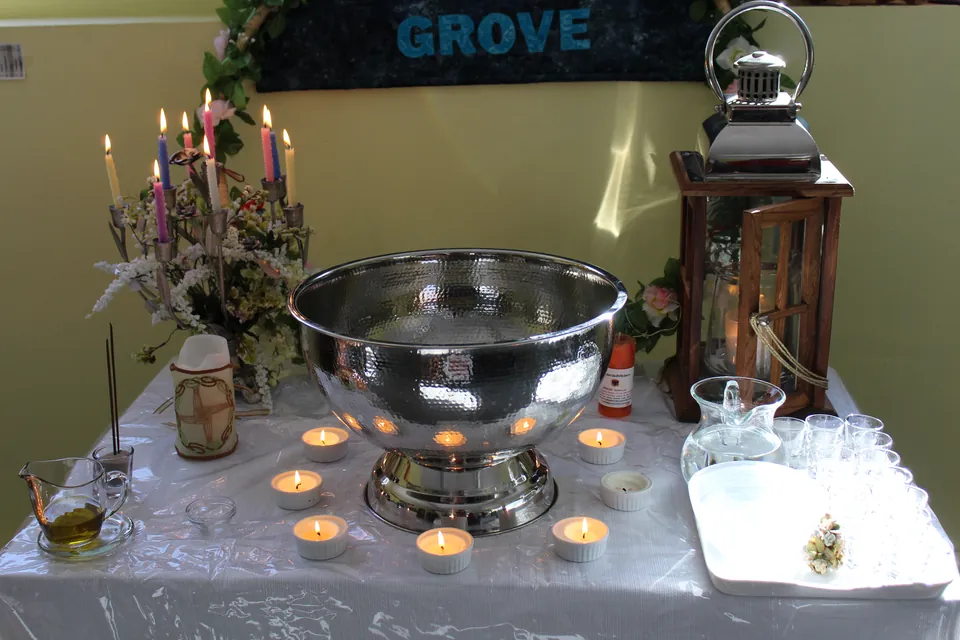
The “silvering the well” question is making the rounds on the DP list again. I find the perennial discussion of this topic interesting because it is an example of the cognitive dissonance created when we try to emulate ancient traditions while living within a modern society.
From archeological studies, we know that there are many places throughout the former Indo-European lands where large quantities of metallic objects are found in either bodies of water or bogs. Some have been intentionally broken or disassembled and others have been sent to their watery grave in all of their former splendor. The generally accepted interpretation is that these objects were cast into the waters as a sacrifice to propitiate the gods or spirits of the location or tribe. They were a gift, perhaps in thanks or perhaps in anticipation of future assistance.
From environmental studies, we know that humanity is a voracious species that strips the environment of resources and discards huge quantities of waste that results in even more damage to the land, sea and sky. We mine for precious metals leaving heaps of tailings to contaminate the water and the land. We burn fossil fuels to shape those metals, send them all over the world and bring them home from the store; all while producing greenhouse gasses, acid rain and ground level ozone.
It is no wonder that there are many people who pause at the idea of “silvering” the well. To purchase silver, even in small quantities, is to support the industry that produced it. To bury it in the ground or throw it into one of our already chemically imbalanced waterways, not only supports the industry that produced it, but also leaves behind an ecologically questionable souvenir for future generations to address. Yes, pouring concrete around it contains it for a time, but only for a time. Yes, silver is not tremendously reactive from a chemical point of view, but neither is it completely inert. You never know what the guy upstream just tossed in the river or buried in the ground.
Reconciling a desire to be ecologically conscientious and a desire to emulate the religious practices of the cultures from which we draw our inspiration is indeed a conundrum. We have access to far more dangerous materials and have learned the consequences of their misuse at a tremendously high price. It gives us pause as we look at our Well. Is there no environmentally kinder solution?
When civilizations decline and ultimately disappear, they leave behind fragments of who they were for us to puzzle over. Some fragments have a better “shelf life” than others. A bouquet of flowers tossed into a river as an offering probably has a shelf life of a few days and when it “expires” it does so miles from where it was offered. An ornamental knife tossed into a river make take thousands of years to breakdown, depending on what it is made of and while it may move downstream as part of the river bed’s sediment, it won’t stray that far. Three thousand year after the offering is made, we may puzzle over the knife, but we most likely won’t even know that the flowers existed. Does it mean that ancient cultures didn’t offer items that have short shelf lives? Maybe, but I tend to doubt it.
So where does that leave the question of “silvering” the Well? If “silvering” the Well is about making an offering or sacrifice to transmute it into a Gate, is it OK to offer something non-metallic? Does that betray the traditions we have reconstructed from the archeological evidence left behind by our ancestors? Can we deviate from ancient practice in name of modern environmental sensibilities?
Ultimately, I think that is a question each person has to answer for him or herself. I think however, it is important to remember, that just because it is not still sitting there for us, 3000 years later, doesn’t necessarily mean it wasn’t considered an appropriate offering. It simply may have been “recycled”.